
What is RevenueCat and Why Is It a Powerful Tool for Apps?

The short answer
RevenueCat is a subscription infrastructure platform that handles in-app purchases, entitlements, and revenue data across iOS, Android, and the web. It removes the need to build and maintain your own receipt validation and subscription backend. In our experience, it is most valuable when you need clean cross-platform subscription data and the ability to change paywalls without app updates.
Contents
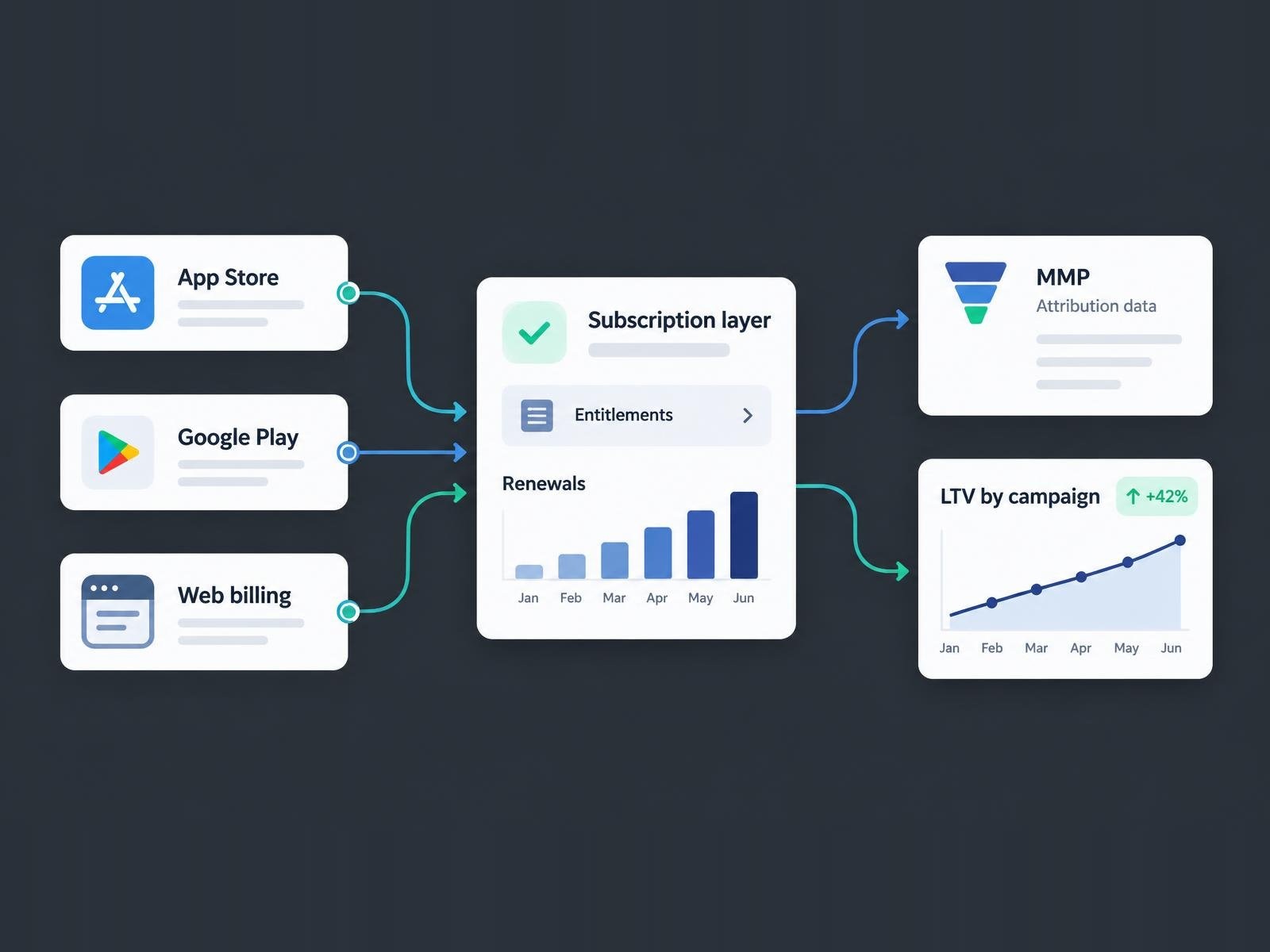
RevenueCat sits between your app and the App Store, Google Play, and web billing providers. It validates purchases, manages entitlements, and provides a single view of subscription data. For related measurement topics, see our guide on how to choose the right MMP. For full app growth work, see our mobile app marketing services.
What does RevenueCat actually do?
RevenueCat provides SDKs for iOS, Android, and other platforms. You integrate the SDK, configure products and entitlements in the dashboard, and RevenueCat handles receipt validation, subscription status, and cross-platform entitlements. Users can purchase on one platform and access content on another.
It also offers remote paywalls, experiments, analytics, and integrations that send subscription events to tools such as MMPs, analytics platforms, and marketing tools.
What this means for your decision: It replaces the need to build and maintain your own server-side purchase logic and subscription status system.
Why is it useful for apps?
Building reliable subscription infrastructure is time-consuming and error-prone. Store rules change, receipt validation is complex, and keeping entitlements consistent across iOS, Android, and web is hard. RevenueCat handles this layer so teams can focus on the product.
It also gives a single source of subscription data that can be used for analytics, customer support, and marketing automation. In our experience, teams that already have meaningful subscription revenue benefit most because the data and paywall tools become more valuable as volume grows.
What this means for your decision: The main value is reduced engineering time on subscription plumbing plus cleaner revenue data across platforms.
What features matter most?
Key capabilities include:
- Cross-platform entitlements so a purchase on one platform unlocks access on others.
- Remote paywalls that can be updated without shipping a new app version.
- Experiments to test pricing, packaging, and paywall design.
- Analytics and charts for subscription metrics, cohorts, and revenue.
- Integrations that send purchase, renewal, and cancellation events to MMPs and other tools.
- Web billing options (including connections to Stripe or Paddle).
Not every team needs every feature on day one. The SDK and entitlement management are usually the starting point.
What this means for your decision: Start with the core subscription infrastructure. Add paywall experiments and advanced analytics once you have volume.
How does RevenueCat help with LTV and campaign revenue?
RevenueCat tracks the subscription lifecycle: trials, conversions, renewals and cancellations. Through its MMP integrations, it sends these events server-side to tools such as AppsFlyer, Adjust or Singular. That way, revenue that arrives later, including renewals that happen when the app is closed, can be attributed back to the campaign that drove the install. This is what makes LTV by campaign possible for subscription apps.
When you turn on this integration, remove client-side revenue tracking from the MMP SDK. Otherwise the same revenue is counted twice.
What this means for your decision: If you buy users with paid campaigns and need LTV by channel, RevenueCat's value is less about the paywall and more about getting real renewal revenue into your MMP.
How does pricing work?
RevenueCat’s Pro plan is free up to $2,500 in monthly tracked revenue (MTR). Above that, it charges 1% of MTR. Enterprise pricing is custom. Growth tools (such as certain paywall features) can be used separately and are charged on the revenue they track.
Always check the current pricing page, as thresholds and terms can change.
What this means for your decision: The free tier is useful for early-stage apps. Once monthly tracked revenue exceeds $2,500, the 1% fee becomes a real cost to factor into your unit economics.
When is a tool not the answer?
A subscription platform is not the answer when the core product or pricing model is still unclear. Adding infrastructure does not fix low conversion or weak retention. If campaign-level revenue attribution is the current gap, start with a clean MMP setup.
What this means for your decision: Fix product and measurement fundamentals before investing heavily in subscription infrastructure tools.
What should you check before using it?
Before committing, check:
- Whether your app needs cross-platform entitlements.
- How you will handle web purchases if you have them.
- Whether the free tier is sufficient for your current volume.
- How subscription events will flow to your MMP and analytics tools.
- The engineering effort required to integrate the SDK versus maintaining your own system.
What this means for your decision: The tool is most valuable when you already know you need reliable cross-platform subscription management.
For iOS measurement, see our guide on what ATT is and how it affects iOS campaign data.
FAQ
No. It supports subscriptions, one-time in-app purchases, and other monetization types, but most teams use it primarily for subscriptions.
Yes, if you run paid user acquisition. RevenueCat handles subscription status and can send events to your MMP, but it is not a replacement for attribution.
Yes. Remote paywalls allow changes to be published from the dashboard without shipping a new version.
On the Pro plan, once your monthly tracked revenue reaches $2,500, you pay 1% of the revenue you track. For example, at $2,500 MTR the fee is $25. Check the official pricing page for current terms.
Yes for the free tier and basic infrastructure. The more advanced analytics and experiment features become more valuable as volume grows.
What to do next
Not sure whether RevenueCat fits your app’s subscription setup?
Talk to our team. We will look at your current stack and tell you where we would start.
Talk to our teamRelated Articles
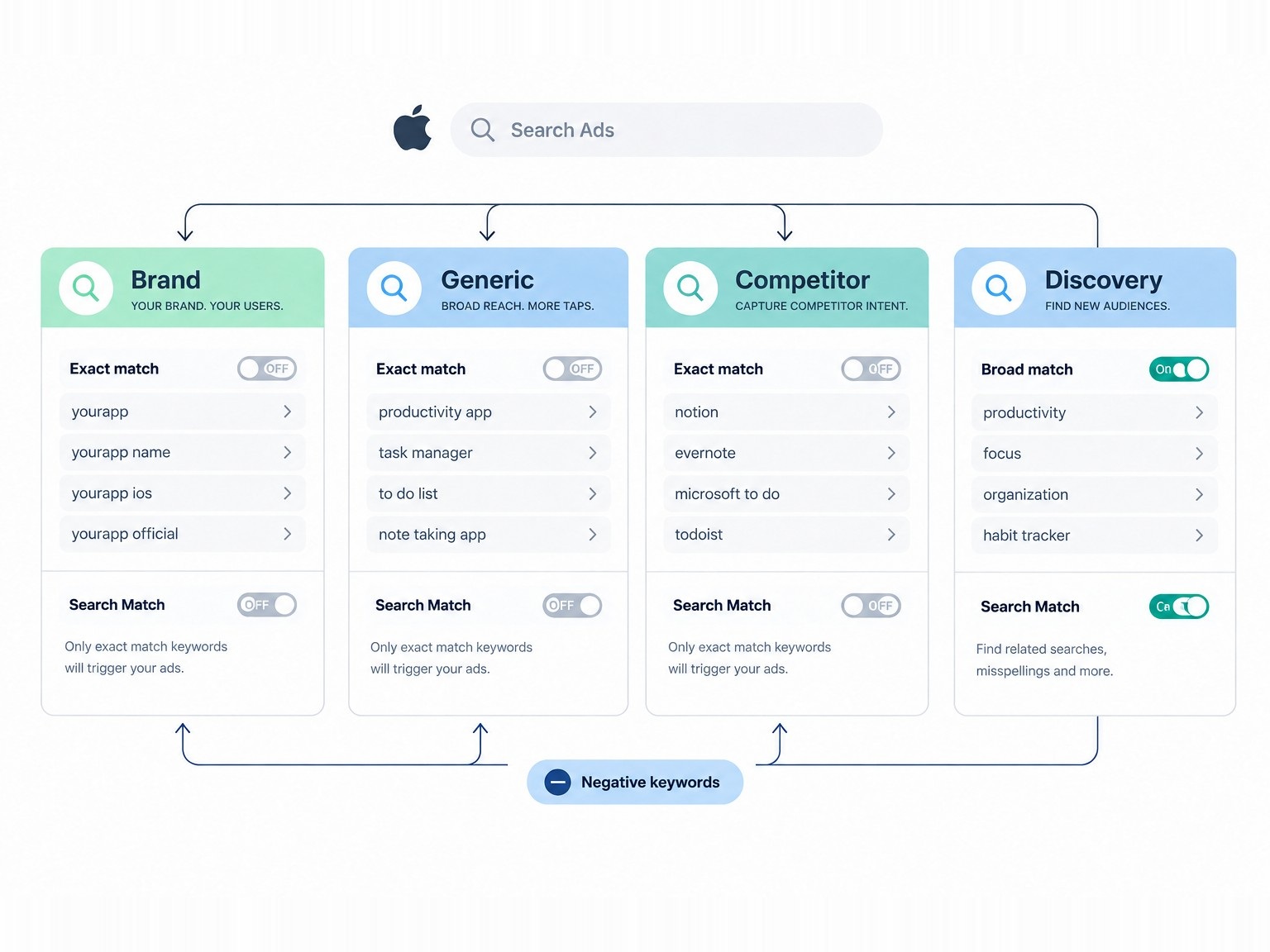
How to structure Apple Search Ads: brand, generic, competitor and discovery
November 23, 2026
How to structure Apple Search Ads into brand, generic, competitor and discovery campaigns, plus when management tools help and what the free plans cover.
Read More
What is ATT, and how does it affect your iOS campaign data?
November 23, 2026
What App Tracking Transparency is, how the prompt and pre-prompt work, and why most iOS campaign data is now aggregated and delayed.
Read More
How Google App Campaigns Work, and Which Levers You Actually Control
November 23, 2026
Google App Campaigns are mostly automated. See which levers you still control, why in-app events matter most, and what to check before you scale.
Read More